Hosted by SALL , contributed by Gaio-Oliveira on 25 November 2022
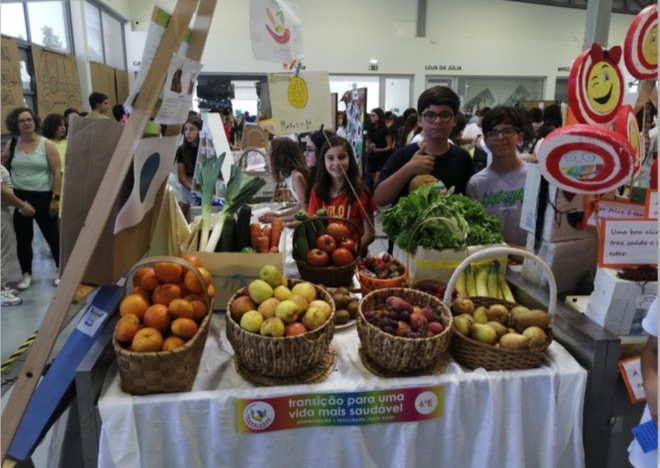
6th grade students found that their schoolmates had little knowledge about processed foods and ate little fruit and vegetables. Applying the living-lab methodology, on Grouping Day, students will carry out an awareness-raising action for the school community, encouraging people to consume fresh and local natural foods and adopt a healthy diet.
Background
In the first semester, the students worked on the topic Nutritional transitions within the scope of the interdisciplinary project, when the SALL project was presented to them. After reflecting on their school and respective spaces, several problems were detected that could be the basis of the project, however the students expressed more interest in some conclusions drawn from the statistical treatment of the survey applied to students of the 2nd Cycle of the school, in the scope of the class's interdisciplinary project. The students decided that they wanted to improve students' knowledge of processed foods and make them aware of the importance of fruit and vegetables in their diet.
Note: participation in this project is the students' first experience with the living-lab methodology.
Aim
With the application of a survey, the students concluded that students in the 5th and 6th years of school have little knowledge about processed foods and that they do not value fruit and vegetables very much in their diet. The class decided to promote an awareness-raising action for the school community with the aim of promoting the consumption of natural, fresh and local foods and also increasing people's knowledge about processed foods, referring to the nutritional transition (theme of the class's interdisciplinary project). . This action had several initiatives from an exhibitor (newsstand).
Before thinking about the prototype, the students carried out a research work in order to improve their knowledge about the themes, having compiled all the information in a digital book that served as the basis for the following phases of the project. With the awareness action, the school community will be able to become more informed about processed foods, will be able to reflect on their diet and come into contact with natural, fresh and local foods, becoming more aware of the importance of consuming this type of food.
Through the collaboration of partners, the community will receive bags of fruit and vegetables. In this way, partners make their products known and demonstrate their involvement in local community initiatives to promote health. With regard to the City Council, it is a partner that has always collaborated with the grouping and will continue to support the school's initiatives.
Co-creation with societal actors
Local farmers (wholesalers) and Intermaché were identified as possible collaborators, as it is from them that fresh, natural and local food reaches the local community. The partners only had an intervention in the implementation phase of the awareness action with the donation of fresh and local natural food.
As for Alcanena City Council, it provided the space for the event.
Note: All local fruit and vegetable outlets were contacted.
Implementation
CO-CREATION
The theme of food systems was presented to the students of the 6.E class through the viewing of a video and the exploration of its content was carried out. Video link: https://www.youtube.com/watch?v=cOt3LBBori8 Problem identification In an initial phase, students identified several problems at school that could be improved, among which, they found that students knew little about processed foods and fruit and vegetables were not always part of their daily diet. This problem was previously identified in the conclusions of a survey applied to school students at the level of the 2nd Cycle, within the scope of the interdisciplinary project of the class “Nutritional Transitions”. Access link to the digital book created by the students and which served as the basis for some stages of this project: https://www.storyjumper.com/book/read/118691312
PROBLEM SELECTION
They decided that among these three problems they would focus their attention on the students' low consumption of fruits and vegetables, this being the base problem from which they would develop the project. The students, using the “Problem tree”, defined the causes, consequences and solutions for the selected problem. Students thought of various strategies to raise community awareness of the importance of fruit and vegetables in their diet and also to improve their knowledge of processed foods. After a detailed analysis, the students concluded that they could put the various ideas together and compile them into an awareness event for the school community on an exhibition stand: - natural, fresh and local foods and with processed foods (show differences); - slogans for healthy eating; - exhibition of Mediterranean food pyramids; - offer of fresh and local fruits and vegetables to the community donated by partners; - supply of natural juices; - Projection of the digital book; - Mandala 3D alluding to the nutritional transition.
PARTNERSHIPS
The students went to the municipal market and to the village's Intermaché and explained the SALL project to local farmers and the owner of the aforementioned establishment, requesting their support for the donation of fruits and vegetables.
The Grouping already has a partnership with the City Council in the provision of spaces for this type of event – Day of the Grouping.
EXPLORATION
Students fleshed out the idea by performing a Starburst:
Who?
Who will set up the bank?
Who will pick up the food for the bank?
Who will make the juice and kebabs?
Who will distribute the bags with the fruit/vegetables? Who will handle the presentation of the digital book? Who makes the labels to put on the bags?
Who organizes the food in the bags?
What?
What material are we going to build the stand with?
What fruits and vegetables are we going to put on the stand?
What processed foods are we going to put on the stand? As?
How will the bank be set up?
Where?
Where do we get the processed products?
Where do we get the natural products?
When?
When will the event take place? When are we going to set up the bank?
Because?
Why will people come to our stall? Why will people accept our offers? Why will people see our digital book?
ELABORATION OF THE PROTOTYPE
The students created a prototype of the stand/exhibitor and the mandala in written form – drawing.
EXPERIMENTATION
In the experimentation phase, there were some meetings between the teachers to define details regarding the organization of the Grouping Day, an activity in which the awareness event is framed.
Before the day of the grouping, with the material already on display at the stand/exhibitor, assembled we carried out a simulation of the idea elaborated in the prototype, however it was necessary to make some changes to the initial prototype. As for the digital book, as it was not possible to place it on the stand/display, it was shared by Teams with the Parents.
REFORMULATION OF THE PROTOTYPE
The space allocated to the class in the municipal market did not allow for the assembly of the stall as planned, so the students proceeded to modify the prototype according to the available space. It was also found that it would be easier for students to make the orange juice and lemonade at home and not at the stand as initially planned, on the day of the awareness-raising action (Grouping Day).
EVALUATION
Students and teachers evaluated the final prototype, decided to validate it and put it into practice.
SETTING UP THE STAND/EXHIBITOR AND RAISING AWARENESS
The students offered lemonade, orange juice, assorted fruits and vegetables to the educational community, encouraging the consumption of natural, local and fresh products.
The community was invited to visit the stand and read the awareness slogans created by the students.
Reflection
The balance is positive on several levels. The students got involved in a project whose methodology allowed them to be the main actors in identifying a problem and in the entire process of its resolution. In this project, students developed new skills and positive attitudes, and conceived science learning as a way of actively contributing to the well-being of the community in which they live. Although the participants considered that the objectives had been achieved, at the end of the application of the prototype, they found that on the day of the awareness raising action, they could have printed the slogans in the form of leaflets prepared by them and distributed them throughout the community, in order to complement the activity and as a measure to reinforce the objectives.
Futurel Plans
This project was completed this school year, after the event on Grouping Day.
Personally, I would like to develop a new project for the next school year, but everything will depend on the school where I teach, the characteristics of the school and the respective classes.
With regard to students, I consider it important to continue to have contact with this type of project and, in this way, to develop skills that are transversal to the curriculum, making them more active, critical and intervening agents in society and more specifically in the community in which they are inserted.