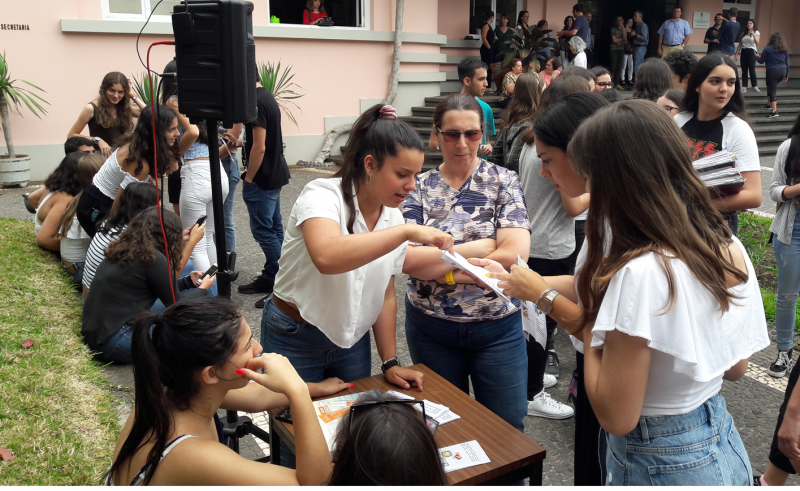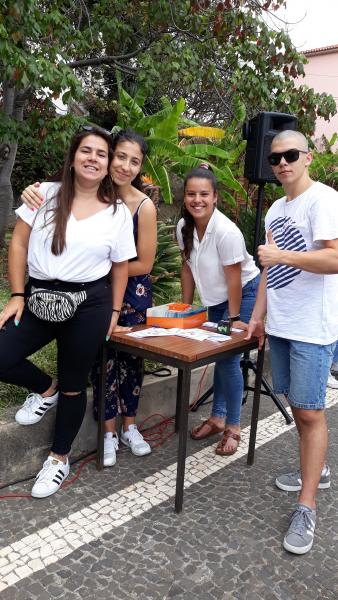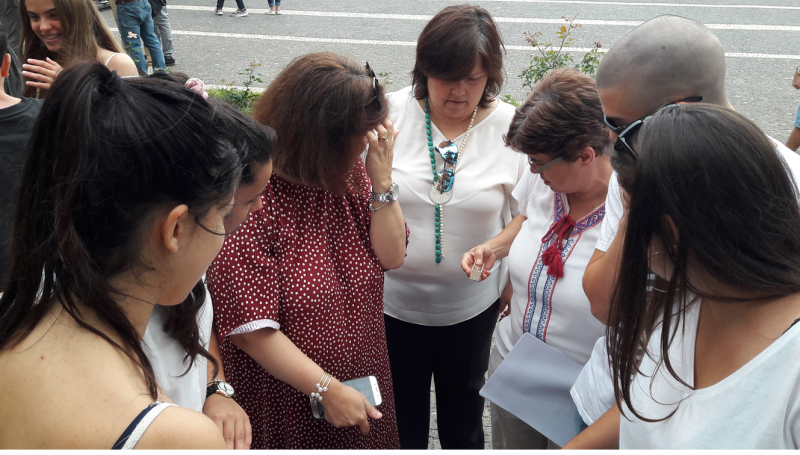
Hosted by OSOS , contributed by Elisabete Chaves on 23 April 2019
This accelerator is created for students from 5th to 12th grade (teachers can make minor adjustments accordingly) however it can be used by kindergarten and primary school teachers. Tips on how to adapt it to these ages can be found in this teacher guide document
------------------------------------------------------------------------------------------------------------------------
Hello there explorer,
I am glad you found this activity! Are you ready to put science into action and learn all about light, radiation and its relationship with our body?
Explore the fun exercises suggested in this activity and discover if UV radiation is in fact a foe, a friend, or maybe both? Then, discover what your community thinks about it, how the people in your family behave regarding it and help your community to act in an informed way towards the sun.

Information for the teacher:
This accelerator was created in the framework of the project - IDiverSE (Islands Diversity for Science Education - 2017-1-PT01-KA201-035919), co-financed by the Erasmus+ agency of the European Union).

The texts are written directly for the students and in a language that students will understand. Teachers are invited to explore it, copy it and edit whatever they feel necessary before they share it with their students. Specific guidelines were added to the four phases, where teachers can read the full content of the accelerator.
Supporting documents and translations to other languages can be found through the following link: http://idiverse.eu/uv-radiation-friend-or-foe/
For any additional info on this accelerator, please contact info@idiverse.eu.
Learning objectives
Students will contact the scientific method in an Inquiry-Based activity that will lead them to learn important concepts such as the Sun and other stars, the solar system, scales in the universe, light spectrum and radiation, UV light and health. Students will also evaluate the level of awareness of their families and communities, creating then an adjusted awareness raising plan.
While going through this project, students will develop fundamental skills such as problem solving, critical thinking, communication, creativity and collaboration. They will also develop other important skills such as tolerance and respect since they will be collaborating with students from different cultures and different environments.
Furthermore, students will be called into gaining awareness for very important health issues of this century.
Opportunities to collaborate with stakeholders
Students will be challenged to interview, discuss and collaborate with their families and other community members as well as to collaborate with different experts on the field such as researchers, doctors, medical institutions, sunscreen brand, etc. Teachers should allow students to invite experts to their school, to collaborate in their creations as well as family members and any other important stakeholders.
More specifically:
1 - In the Feel phase, students will use a collaborative platform to collect data from their community and compare it with data from other communities. For this, they will bring home a survey with 4 questions to make to their parents, siblings, grandparents, etc.
2 - In the Imagine phase, students will be advised into bringing the problem to their families and have important discussions about the causes and solutions to the problem at hands. Teachers will be advised to allow students to invite an expert (stakeholder) of their choice such as a University working on the field, a health care centre or any other important stakeholder of their choice.
3- In the Create phase, students will be encouraged to collaborate with their families, community members and important stakeholders in their creations, making them more effective and a co-creation product.
4 - In the Share phase, students will reach out to the whole community to share their work, including important stakeholder entities who can reinforce the change-making progress.
Responsible Research and Innovation
One of the key aspects of OSOS is the inclusion of RRI - Responsible Research and Innovation - principles (RRI-Tools.eu). This is how this accelerator fits in the RRI model:
|
Governance |
This accelerator is based on a fundamental key point which is to teach students what science is and how to make a valid and respectful science research. It highlights the fact that science needs to be shared in order to be valid, it needs to be transparent and collaborative so as to contribute to the development of our society. In this project, students reflect with the community on the problem and will co-create possible solutions sharing, in the end, all their work, including their research process. Furthermore, students will share their results and conclusions with other communities in islands worldwide, through a platform called globallab and through the collaboration between their teachers. |
|
Public engagement |
Students will interview their communities as well as important stakeholders, i.e., experts in the problem they are working on. After collecting their data, students will discuss with their parents, other family members, friends, community, etc, about possible effective and applicable solutions to the problem in their communities. The whole activity will focus on the engagement of students with their community so as to take into account their real needs when solving a problem. |
|
Gender Equality
|
The problematic involved in this project is transversal for all humans in the world, regardless of their gender. At no moment, the gender of the students will be asked or relevant. On the resources created for the teachers advise is given in order to provide equal opportunities, not only for both genders but also among all the different personalities. In the guidelines given to the students an effort is made to use both male and female role models as inspiration, as well as male and female icons and individuals in pictures. Teacher are also advised to find experts of all genders and invite them to work with their students. |
|
Science Education |
Students will be engaged in Inquiry-Based activities that will lead them through the scientific method and reasoning. It is expected that after creating their projects, students will have understood what science is and how scientific knowledge can be obtained and communicated. By working with the community and sharing their work in the end, students will bring science education to their community as well as awareness for important scientific questions. |
|
Ethics |
During the project students will understand that cooperating and collaborating is a much more valuable effort than competing, and that knowledge and good ideas should be used in an ethical way and shared with others. When in collaboration, Scientists can overcome nearly any obstacle and provide what is necessary for a safe, developing and growing society |
|
Open Access |
After finishing their research, students will share all their work with the community, providing a fully open access to their data and conclusions. |
Kuvittele
https://www.saudecuf.pt/mais-saude/artigo/protetor-solar-tudo-o-que-deve-saber
Protetor solar: tudo o que deve saber
A utilização do protetor solar tem suscitado algumas dúvidas na comunidade científica. Esclarecemo-las já a seguir
Publicado por: Miguel Peres Correia em 16 de Junho 2014
Tags: cancro de pele , proteção solar , radiação ultravioleta

Nas últimas décadas, o cancro de pele tem conhecido um aumento significativo de número de casos. Pelo seu potencial efeito preventivo desta doença, os protetores solares têm sido objeto de uso cada vez mais comum.
Polémica em torno do protetor solar
No entanto, tem-se questionado se o uso de protetor solar, pelo facto de sabermos que evita a queimadura solar, não levará a que o tempo total de exposição solar aumente, com risco acrescido de cancro de pele. Por outro lado, têm também surgido dúvidas sobre o potencial efeito negativo do uso de protetor solar no que toca a possibilidade de reduzir os níveis de vitamina D para valores patológicos.
Protetor solar sem dúvidas
Para esclarecer estes assuntos, a Food and Drug Administration (FDA), organismo regulador do medicamento nos EUA, emitiu um parecer e regras específicas. Concluiu-se que o uso de protetor solar, associado a outras medidas de proteção solar, reduz o risco de cancro de pele e o envelhecimento da pele exposta à luz.
Em estudo comparativo verificou-se que o grupo de indivíduos que aplicou protetor solar diariamente teve metade do número de casos de melanoma que o grupo que usou protetor solar de modo ocasional.
Como escolher um protetor solar
Para cumprir a sua missão, o protetor solar deve reunir um número de requisitos:
- Ser eficaz face à radiação ultravioleta B e A. A capacidade de defesa em relação a cada um destes tipos de radiação deve estar expressa no rótulo.
- O comportamento do protetor no tocante ao contacto com água ou suor, nos casos em que tal seja aplicável, deve ser afirmado como resistência à água e não como sendo “à prova de água”, pois esta expressão não é verdadeira.
- O período de resistência à água deve ser descriminado como 40 ou 80 minutos.
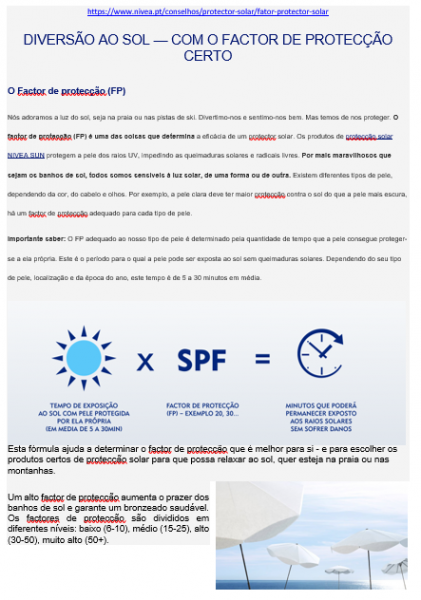
- No tocante ao fator de proteção solar (FPS), recomenda-se que o fator máximo reclamado seja 50+.
- Para que um protetor solar seja considerado de espetro largo o fator de proteção deve ser 15 ou mais, nesse caso pode estar escrito no rótulo que contribui para a redução do risco de cancro de pele.
Componentes perigosos?
No tocante à polémica relacionada com alguns componentes do protetor, oxibenzona e retinil palmitato, conclui-se que o risco de não usar protetor solar é muito superior a qualquer potencial risco associado a algum componente.
Proteção solar vs. vitamina D
O problema dos níveis baixos de vitamina D devido ao uso de protetor solar foi completamente desmentido por diversos estudos que envolveram populações de idades variadas e em circunstâncias de vida real, não de cenário de laboratório.
Os diversos estudos realizados demonstraram não haver evidência que suporte a afirmação que o uso diário de protetor solar levaria a redução dos níveis de vitamina D.
Use protetor solar diariamente!
Todos estes dados expostos pela Food and Drug Administration levam à recomendação de uso diário de protetor solar com o objetivo de reduzir o cancro de pele e as manifestações de envelhecimento da pele.
Luo
Jaa