Liigu edasi põhisisu juurde

Clone of S.T.R.E.A.M.+A., (Small Town River Earns Attention and More…)

S.T.R.E.A.M.+A., (Small Town River Earns Attention and More…)

Hosted by OSOS , contributed by 12schAgDim on 29 June 2021

Environmental protection and its utilization, taking account of the sustainable development, becomes a necessity in our ‘rapidly-changing’ era. In our city’s environment, there are unexploited resources which could be integrated in the citizens’ everyday life, within the frameworks of sustainability and with respect to their existence and their characteristics, improving everyone’s quality of life.

The current research involves the exploitation of the ‘Picrodaphne Stream’, of the Municipality of Aghios Dimitrios, of the Attica Region, on the bank of which the 12th Primary School is built.

The main question is, the way in which students can exploit the stream as a stimulus of their searches in Natural Sciences, the proposals of improvement that can be done and how to become implemented in the frameworks of sustainability, urban accessibility and how to be included in STEM Methodology and Robotics. The students implemented quality and quantity research, a project calendar and observation. The results of the action showed that the students became active, collaborated, derived knowledge and the experience of Research Methodology, while taking the pleasure of creating and doing Robotics. 


teachers:Aikaterini Goltsiou, Ioulia Kapsali, Filippos Papazis, Theodore Stamatakis, Lambrini Amarandou
Learning Objectives
Mathematics, Physics , Science, Technology, Programming, Language, Art

How can the abandoned nearby natural environment of an urban school become a space of micro-climate research and an extension of the school’s environment? Is it possible for the neighbourhood residents to exploit it and make it accessible to people with Physical Disabilities?  What proposals can students make to create ‘Green Sidewalks’, so as for all these to be achieved?

Our basic aim was for students to become involved in the research of the redevelopment of the abandoned place of the Picrodaphne stream, on the bank of which their school is built, so as for it to become easily accessible to the entire School Community, the neighbourhood residents and the district. For the students it will become a space of action and permanent study, as an extension of the school environment and a recreation area for everybody. The school plays a vital role.

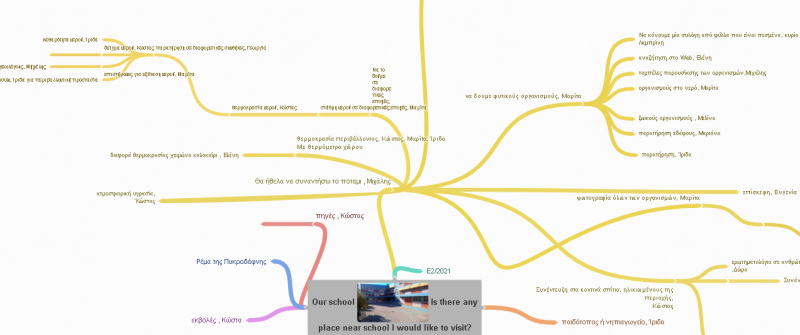
The initial research for a place for recreation near the school was recorded ‘on line’, through brainstorming, in a Concept Map Web 2.0. An eTwinning project titled S.T.R.E.A.M.+A., (Small Town River Earns Attention and More…) was created for collaborative writing.

εννοιολογικός χάρτης

 An online research of the resources, concerning the biodiversity of the stream was considered necessary, the students were divided into teams and they worked on the flora or fauna. A visit to the stream was initially considered impossible because of the pandemic conditions, so the students had to imagine the place of the stream and they drew logos for S.T.R.E.A.M.+A. Through the online research and the presentations in the online classes and the eTwinning there were proposals for workflow and the fulfillment of the activities. A part of those were completed online, while the experiential part was done when students returned to school.

The project’s objectives:

-To promote the students’ involvement in Technology, Programming, Mathematics and Science.

-To make it clear that there is a connection between Science and everyday life.

-To strengthen skills like critical thinking, problem solving and evaluation.

-To develop collaboration and communication.

-To practise and boost creativity.

To approach the subject we implemented the Cross-Curricular method and quality and quantity research. Mathematics, Physics , Science, Technology, Programming, Language, and Art were the school subjects that we made the most of. 

The students took action by interviewing the elderly residents of their neighbourhood, trying to mnemonically depict the area in the past. Questionnaires were completed by the students’ parents, so as to investigate the tendencies and the opinions of the residents, in relation to the stream and so as to make proposals of improvement.

A group of students(class E2) recorded the activities in a Project Calendar.

They presented themselves as researches. They took pictures of the neighbourhood so as to give a position in the map.

The recordings of the temperature of the stream and the neighbourhood had as a goal to compare the surrounding area and to create diagrams for reaching conclusions.  

Logos were drawn and there was also a competition between 2 classes (E2 and D2) for choosing the best logo that would accompany the project.  

A student recorded the searches related to the flora and fauna on video.  

The students took up roles in a role-playing, for creative writing in a wiki and a student also created an animation.


A ‘Letter to the Mayor was written collaboratively, as a first approach of working on the subject.

All recreation proposals were recorded in a common presentation.

While visiting the stream, we conducted experiments, concerning water ph and observation of water clearance and biodiversity.


The students’ proposals led to a scale Model with proposals of improvement, recreation, accessibility of the future exploitation of the Picrodaphne stream from the broader school community and the neighbourhood and the integration of Robotics.

How was Robotics integrated in the Project? We used Lego Education WeDo 1.0 and Lego Education WeDo 2.0. Let’s take a look at our school:

The children are playing and chatting at the school playground. How is it possible for a person with special needs to move and approach the stream? With ‘Green Sidewalks’. The vehicle follows the white line on the street. When  the line ends, the sensor of distance ‘feels’ it and the vehicle stops. The person can follow the paving stone and approach the river. Those who can see can enjoy the sounds of the stream and its cool breeze, while sitting on the bench and being under the photovoltaic lights. When the sun is up, there is daylight, so the lights of the mechanism are off. When the sun has set, when it is lost from the horizon, the lights turn on, offering the visitor a soft lightning, with respect to the surrounding environment and without light pollution. The distance sensor perceives that sunlight has diminished, so it gives the order to the lights of the construction to turn on (in the video, the child’s hand plays the role of the sun that moves away and the light is diminished).

After the visitor takes his walk, he or she returns to the neighbourhood, his house or the school if he is a student. The distance sensor leads him back to the starting point.


The students used new technologies and collaborated in common presentations, in person or online, thus cultivating their digital literacy. They acted by implementing research methodology and their suggestions, as well as the results (quantity and quality researches, written creations, art works, videos e.t.c.) were presented or shared:

  • In the calendar of the intra-school eTwinning project, S.T..R.E.A.M.+A., that was created for network collaboration,

  • To the Mayor of the Aghios Dimitrios district, for implementing the recreation proposals (we had a visit of the Mayor in our online class),

  • To Harokopio University, in the Department of Economy and Sustainable Development.

  • In the  blog of the  project S.T.R.E.A.M.+A., that was created

  • In the page  ERASMUS +KA3 of the school blog, where the Project’s blog was incorporated

  • In a teacher’s blog (ICHNOGRAFIMATA)