Hosted by SALL , contributed by Gaio-Oliveira on 20 January 2023
The outer space of the school is not very attractive for students to make adequate use of it, not only during breaks between classes, but also in longer periods when they have to stay at school, such as lunchtime, or when they are not have classes. On the other hand, the school's teachers make little use of the outdoor space as a place of learning, or as a place where they can develop their learning.
Background
We are a school considered TEIP (educational territories of priority intervention), on the south bank of Lisbon, located in the municipality of Seixal, parish of Amora, with about 25 years of existence. The school consists of 3 blocks, interconnected by closed corridors, in the middle of an urbanization of medium population density. The internal circulation between classrooms and social spaces, library or cafeteria can always be done in a sheltered space, or alternatively through the external spaces of access to the pavilions.
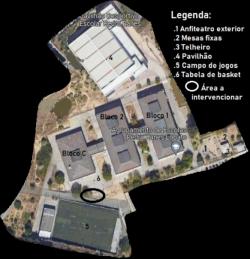
In the outer space, there is a small auditorium, next to the school entrance, a shed where there is a fixed ping-pong table and a set of three concrete tables, which only allow seating for 12 students. In the remaining space of the school, there are also two metal benches in one of the lateral areas. There is also a small living space next to one of the access doors to the building, consisting of two small walls, where students usually sit, but which are located next to classroom windows. In the unpaved space of the school there are some green spaces, and other places where students can remain, but standing. In the upper area, next to the cafeteria, there is also a space with a basketball court that students can enjoy freely – see figure 1.
Thus, it can be seen that abroad, students do not have a place to stay, which allows them to receive students, in times without classes, or where teachers can come to teach a class abroad.
With the various interventions that have been taking place at the school, namely with projects within the scope of the participatory budget, Erasmus+ projects or alternative training offers, the students and the school have sought to find solutions to improve the outdoor space. This possibility of training students to intervene in the community has also been encouraged by participating in projects such as EcoSol or in activities within the scope of the Citizenship and Development discipline.
Aim
The outer space of the school is not very attractive for students to make adequate use of it, not only during breaks between classes, but also in longer periods when they have to stay at school, such as lunchtime, or when they are not have classes. On the other hand, the school's teachers make little use of the outdoor space as a place of learning, or as a place where they can develop their learning. The project will seek to boost the school community, so that solutions can be found so that the school's outdoor space can effectively be another resource for the integral development of the student, whether in a formal or non-formal context. The existence of these spaces will also allow the possibility for students to reduce conflict activities between peers, as it may provide places for less physical activities and less contact with each other.
Co-creation with societal actors
The students presented a proposal to invite the City Councils (Town Hall and Parish Council), the Association of parents and guardians, members of the Board; Erasmus+ School of the Future Project; Students; Operational assistants; EPIS/ Escolhas technicians and the teachers.
These partners were essential in finding a more weather-resistant solution, in choosing where to place the tables, but also in observing the position in which they should be placed. Only by listening to those who are daily in the courtyard in particular, the operational assistants and the students, can we identify, for example, the places with the least conflict with the classes, moving this space away from the building, or the places where spaces can be created where indirect supervision is possible. most favoured.
Implementation
Dynamics and methodologies applied in identifying the problem:
Through assemblies of delegates, informal conversations with students in the Citizenship and Natural Sciences classes, as well as in the meetings of the pedagogical council, the participants were questioned about the problems that existed in the school. In addition to the Citizenship classes, students on a field trip around the school randomly questioned students/teachers/operational assistants on the school premises so that they could identify a problem that the school had and that they could immediately observe/remember. From the data collected, several problems were evident, and the 5 most indicated are presented below:
- degradation of the sanitary facilities of the students (boys and girls)
- coating of the ceilings of the school building (rooms and corridors), which is being dismantled
- lack of sufficient outdoor spaces to stay (there are only 2 benches in the entire school)
- foosball and ping-pong tables broken
- lack of a vegetable garden
Of these problems highlighted, the students with the Citizenship teacher excluded some, as they were already being resolved - albeit not completed, by other projects and entities.
Dynamics and methodologies applied in the selection of partners:
After listening to the opinions, the students in a class assembly, using a brainstorming methodology, defined which partners to involve, sending invitations to participate in the extended world café meeting and then in the more restricted meeting with only representatives of these partnerships.
Dynamics and methodologies applied in identifying the solution:
Create a world café session with at least two members of each partnership, to face the problem, discuss intervention proposals for the diagnosed problem, recording these opinions on sheets on the wall. In each group, one of the Citizenship students will be responsible for collecting ideas and proposals from each partner. The following day, in a more restricted meeting, the students with the representative of each partnership present will outline the solution to be developed, based on the previously provided contributions.
Dynamics and methodologies applied in the development and testing of the prototype:
Using a classroom table and some chairs, students will test in Citizenship classes, the places presented in the solution, during that week, to perceive the place and if the solution will be the most appropriate. After the prototyping period, 5 tables with benches made of recycled material will be acquired to be placed in the space that was considered the most appropriate and which could serve as a place for students to stay, or for teachers to teach. classes abroad if they so wish.
Reflection
The involvement of students in the search for solutions to problems they have identified is by far the best way to solve them and make them work. Not being problems identified by others, or imposed solutions, they end up being more easily appropriated and therefore more effective in their achievement and final result. The possibility of integrating partnerships and joining efforts between projects was an added value. A space that was initially unused, can gain more life in this way, having so far been to the liking of the students and used to teach some outdoor classes.
Futurel Plans
The project itself will not continue, but it has already made it possible to perceive another place, where new tables may be acquired in the next school year. The methodology was presented to the coordination of Citizenship, and to the coordination of the Learning Support Center, so that it can be replicated in other activities and in the Vozes PEL projects and in the Participatory Budget 2023 activity.