Hosted by SALL , contributed by Gaio-Oliveira on 23 November 2022
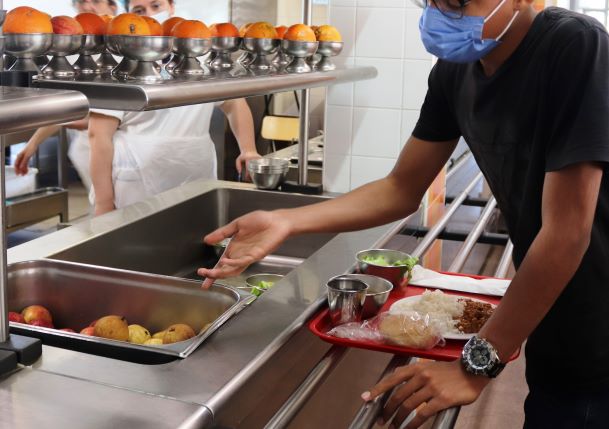
The project began with the determination of the individual ecological footprint. The food factor was considered by the students as responsible for the high value obtained. Then came the idea of monitoring the school lunch service and determining its ecological impact. Problems were identified, community members were met for a joint analysis of the same, presentation of solution proposals and partnership formation. Some proposed solutions were prototyped and the measures that proved to be the most effective were implemented.
Background
The school Pedro Jacques de Magalhães, in Alverca do Ribatejo, has around 975 students in the 2nd and 3rd cycles. Environmental issues have always been a challenge for the school, which is why, for some years now, projects have been developed in the field of the environment (eg. “Sustainable Cities”; “OSOS”- Open Schools for Open Societies”; “Walk the Global Walk”; “Gardens in action” promoted by the Clube Ciência Viva na Escola and “Erasmus Mais – Sustainability for our future”).
Since changing mentalities is a time-consuming but desirable process, it is necessary to continue investing in projects that not only intensify the school-local community connection, but also make these actors co-responsible for solving day-to-day problems. The pertinence of the theme and the methodology of the SALL project were reasons for the school to accept the invitation sent by Ciência Viva and participate in the project, right in the first year of its implementation in Portugal.
Aim
The identified problem relates to waste in the school cafeteria, namely:
• high number of meals bought, cooked and not consumed;
• large amount of leftovers on the plates;
• placing paper cutlery bags and plastic bread wrappers in the undifferentiated waste container;
• precarious consumption of fruit served at lunch which, in the medium term, ends up deteriorating.
Solutions found:
• Intensification of the alert for Class Directors - Guardians, via email, about meals scheduled and not consumed by their students;
• requesting help from the local authority to dispose of leftover meals;
• raising the awareness of students and guardians through training actions on food education;
• raising students' awareness of the inclusion of fruit on the tray and possible destinations for it, if it is not consumed at lunch;
• placement, in the cafeteria, of a box to collect fruit not consumed at lunch, for later availability of the same, free of charge, at the buffet;
• placement of two recycling bins in the cafeteria (blue and yellow);
• raising students' awareness of the separation of waste and placing it in the respective recycling bins;
• holding a training course on waste separation for students and employees.
The solutions found are beneficial at several levels, including:
• the free availability of fruit at the buffet to any member of the school;
• forwarding leftover meals to an entity that distributes them to needy people;
• the separation of waste (paper and plastic) for recycling, with an impact on reducing the exploitation of raw materials, among others.
Co-creation with societal actors
In an online meeting with the students, several social actors were suggested who could be an asset in the analysis of the selected problems and in the formation of partnerships leading to their resolution. Although invitations were made to various entities, elements of the Parish Council of Alverca do Ribatejo and Sobralinho attended the meeting with the World Café methodology; Vila Franca de Xira City Council (Department of Education and Department of Public Space Management and Environment); the Directorate of the Pedro Jacques de Magalhães School Grouping; of the Association of Parents and Guardians of Education and the General Council of the Grouping.
Partner contributions:
Vila Franca de Xira City Council – availability to promote training actions on waste management for the school community;
Parish Council - intermediary between the school and the congregation of the Vincentian Sisters for the disposal of cooked and not consumed meals;
Direction of the Grouping and General Council - support in the actions developed and to be developed;
Association of Parents and Guardians - availability for collaboration in actions that may be developed.
Implementation
The project began with the determination of the individual ecological footprint of the group of participating students and with the identification of the food factor as one of the factors responsible for the high value obtained (on average 3.1 planets). Following the analysis carried out on the individual results, the idea arose of trying to understand to what extent the lunch service in the school cafeteria contributed to the sustainability of food systems.
So, after presenting the idea to the Group Management and contacting the representative of the company responsible for school lunches, it was decided to monitor the cafeteria service for a week. In this context, the following actions were carried out:
• collection of information on the production and disposal of waste related to the preparation of lunches, from some employees of the cafeteria;
• observation of food placed by students on trays;
• observation and photographic record of leftovers on each tray;
• weighing the total amount of soup leftovers and the main dish, which cannot be redistributed;
• observation of the destination given to paper cutlery sachets and plastic wrappers for bread;
• data collection on the number of meals sold, cooked and not consumed.
Based on the collected data, problems were identified and partners were suggested who, in a meeting using the World Café methodology, would collaborate in the analysis of situations and their resolution. During the meeting, several solution proposals were listed and the most viable ones were selected. Thus, for a week, prototyping was carried out, with the following actions being implemented in the cafeteria:
• placement of a yellow and a blue recycling bin;
• placement of a box to collect the fruit that, although served at lunch, was not going to be consumed;
• creation of a SALL Intervention Team (students and teachers) whose aim was to raise awareness among users about the consumption of fruit and other food placed on trays, as well as about the separation of waste from bread and cutlery packaging;
• daily weighing of leftover soup and main dish;
• survey of data on the number of meals sold, cooked and not consumed.
After collecting information, a comparison was made with the results of the first monitoring and it was found that there was now a separation of waste; the number of meals sold and not consumed decreased and the number of students who put fruit on the tray increased. However, food waste related to the amount of soup leftovers and main course leftovers increased.
In view of the evaluation carried out and because there were aspects to be improved, it was decided to continue the project in the 2021-2022 school year.
In an initial phase, the SALL Intervention Team developed the following activities:
• awareness-raising action for reducing waste in the cafeteria and separating waste, in all 5th grade classes;
• new monitoring of the lunch service in the cafeteria for an intermediate assessment of the impact of the measures;
After analysing the results of the third monitoring, it was found that there was a need to re-sensitize all students to reducing waste, and the following actions were taken:
• creation of posters with phrases about “Rules and tips” in the cafeteria and placing them in the lunch service line;
• creation of the video "In the school cafeteria" and its use in the classes;
• application of the "Habits and food preferences at home" and "In the school cafeteria..." questionnaires to students in the 2nd and 3rd cycles.
Reflection
The greatest difficulty experienced in the development of the project was the resistance to change on the part of various elements of the educational community. Nevertheless, we believe that the project has contributed to the creation of an environmental conscience and to the development of an active citizenship.
Feedback from some participants:
“The implementation of the SALL project at the school has contributed to the development and adoption of behaviors aimed at protecting the environment. The promotion of moments of reflection with the involvement of students, teachers and partner entities, as well as the carrying out of actions for the free distribution of bread and fruit from the cafeteria and the separation and valorization of paper bags from cutlery (for example, the use of of the same in the school's Christmas decorations), have contributed to a dynamic of a school that promotes values and builds an active citizenship.”
Member of the Group's Management
“It is a project that is necessary. It has been very well applied, it has made a difference and I think it has really changed mentalities, at least mine has.”
9th grade student
“The project has proved to be very positive in the adoption of citizenship behaviors that are an added value on a personal level, but also on a social level. I would like to highlight the free distribution of fruit at the bar, which comes from what would be food waste in the cafeteria and the recycling of paper cutlery bags. The project has provided dynamic and common moments of reflection between the different partners to find solutions to the problems detected, as is an example of this, the "World café".
3rd cycle teacher
“The main virtue of a project of this nature is the involvement of students in all matters related to their life at school. There is often talk exclusively of academic aspects related to formal learning in the classroom. However, reflecting on what we eat at school, food waste and ways to reduce it, help to make future students more informed, responsible and committed citizens.”
2nd cycle teacher
“It was a great privilege to participate in this laboratory with young people who are very focused on problems and solutions. Best wishes to all.”
Element of the autarchy
Futurel Plans
The project will continue in the 2022-2023 school year, with a new team of students. The focus will continue to be on combating waste in the cafeteria so that, in addition to continuing to apply the measures already successfully tested, it is expected:
• the inclusion of the subject "Food education" in the meetings of Class Directors/Guardians, at the beginning of the school year;
• carrying out a training course on waste separation for members of the school community;
• the promotion of an awareness-raising action for students and/or guardians by a nutritionist.