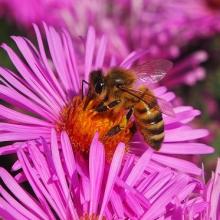
Hosted by OSOS , contributed by DeustoLearningLab on 29 October 2018
Do you like bees? Do you think they are important? What would happen if bees disappeared?
Well, fellow explorer, today you are going to become a scientist researching on one of the most important contemporary science research problems. Although we are used to seeing people run away from bees or associate them with the sweet tasting wonderful food we call honey, bees are so much more than that. Do you know why? Embark on this journey, play a fun game, enroll in an interactive research platform, colaborate with your community and you will become an expert and a very important change maker in the world. Bees will thank you … and humanity as well!
This project is created under the framework of the project IDiverSE - Islands Diversity for Science Education, co-funded by the Erasmus+ agency of the European Union, in partnership with OSOS - Open Schools for Open Societies.
For further information visit: http://idiverse.eu/
Contact: info@idiverse.eu
Feel
Part 1 – Introducing the topic
Do you like bees? What would happened if bees disappeared? Discuss this in class!

Ask your teacher if you have time to play the “web-of-life” game and play it!
Did you play it? What did you think about it? Discuss in class about what the game represents and what you can learn from it. Write your thoughts here.
Watch this video that will illustrate some of the things you might have learned from them game:
So, now that you have learned what Biodiversity is, can you explain what is the importance of bees for the ecosystem? Discuss this with your group and write down your thoughts. You can do it in the form of a mind-map. If you don't know what a mindmap is you can make a quick search online to discover.
Part 2 – Time to make science!
Did you know that Bees are disappearing? Can you find out why?
Ask your teacher for the Link to a research platform where you will investigate this question.
Part 3 – Time for a reflection
Did you finish your research? What did you learn? Write your new ideas about why bees are important and how they might be affected by human activity.
Now watch the following video:
Do you think your personal actions are positive toward bees? And your community?
Some questions to reflect:
Is your community aware about the problems that bees are facing today? Are bees also disappearing where you live? And in other islands of the world?
In the following steps you will investigate these and any other questions that you may find relevant concerning the problem of the bees’ disappearance. You might discover that your community is protecting the bees or maybe it isn't and you will be able to do something about it.
Part 4 – Bees in my community

Are bees increasing, decreasing or not suffering any change in your island?
How is your community behaving toward bees? Are they aware of the problem bees are facing?
Write your hypotheses related to these questions.
Here you will find a project created to help you discover the correct answers to the questions above. It is integrated in a platform called globallab that allows you to collect information about at the same time that colleagues from other islands do and then compare the results in a global level. This specific project is about the status of the bee population in your island and your community’s level of awareness regarding it. It is very important that you follow the guidelines rigorously so that all your colleagues making this activity throughout the world can collect the same kind of data and compare it.
First, ask for your teacher's help when registering in the platform and consider the following:
- Use a code name - your teacher guide you
- Don't use any picture that shows who you are.
- Read all the parts of the project very carefully and make sure you understand all the questions before you start the project.
Return to this page when you finish!
Part 5 – My community (my local world)
Now, using the data you have collected you can organize it and analyse it. Were your predictions correct? What conclusions do you take from your analysis?
Can you now answer to the three questions presented before? What is the current situation of the bees’ population in your island? Are they increasing/decreasing? How is your community behaving toward bees? Are they aware of the problem bees are facing?
Write down your new conclusions and explain how your data supports them.
Part 6 – Other communities (my global world)
What about other islands? Can you use the data collected by your colleagues in other islands to respond to the same question at a global level? Are other communities more or less aware regarding this problem comparing to yours? Can you learn something from them? Can you help them?
Use the discussion utility on the globallab platform to discuss these questions with your colleagues from other islands.
Imagine
Like a bee in a beehive, each one of us is part of a local and a global community, and it is each one of us' responsibility to sustain it for the well-being of all. Likewise, human societies are integrated in a web of life, an intricate web of complex relationships which ultimately allow for the well-being of all species. To preserve it, we first need to become conscious of ourselves and our surroundings. Throughout this activity you are becoming aware of the importance of pollinators in our lives, more specifically bees. You recognized the problems they face on their everyday lives’ efforts to sustain the web of life from which you and your dearest benefit. It is now your turn to share this new knowledge with others and imagine, implement and share your own solutions. The bees will benefit. The world will benefit.

Part 1 – Imagining solutions
What can we, humans, do to help bees and prevent their possible extinction? Write your ideas.
Now, considering your local community. What could your community do to protect the bee’s habitat and increase their population numbers? Can you take an example from other communities that are doing better than yours?
In case you consider that your community is already presenting an excellent behaviour, what advise could you give to other communities? What can your community teach the others?
Part 2 – Be the change in your community
Think about what you can do to help your community and the bees. Discuss this with your parents, teachers, family, friends, people you find in the street. Collect their ideas. What do they think it is important? What would they be willing to change? The most important thing to consider is that whatever you create needs to be applicable and suitable to your community or the community you are helping!
Register all your ideas and discuss how you can implement them with your colleagues.
NOTE: when thinking about possible solutions to be implemented in your island, please pay very good attention to your community members. Don't just think of solutions that you would be willing to implement but think about them and what they are capable of, how they would feel, how could you convince them. Otherwise your work will not be as relevant as it could. The same thing applies when helping colleagues from other islands. Read their data carefully and understand the level of awareness of their community members and what their answers mean. Try seeing the world from their point of view.
Create
Now that you have thought about possible solutions for your community (or others) it is time to create a practical way of implementing them. It can be through awareness promotion, knowledge sharing or actual implementation of something you think about. It is time to put your hands into action.
As before, if you consider that your community is already an exemplary one regarding its behavior toward bees, maybe it will be more valuable if you can create something that will help the other communities, having yours as an example. In case you consider that your community should improve, this is where you create something that will set the path toward development.
Part 1 – What will you create?
Together as a group, decide what type of output you will want to create for the community. You can be as creative as possible. Discuss with your teacher(s) what you can do and how far you can go.
Think about how you will record and register everything you do to share later. Take pictures, make videos, etc.
Part 2 – Create!
Now that you have decided what to do it is time to start. Make sure you have completed the full design of your project before you start and have access to all materials you will need. You will have to work as a team. Be prepared for any changes that may have to be done to your project when in the field. You may need the help of members of your community, your family, other professionals in your community. Discuss the design of your project with them.
Remember to add here all the relevant pictures and other records of your progress.