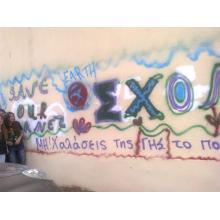
Hosted by OSOS , contributed by Thivea on 8 July 2021
Green School - Gray school and strategies to enhance the sustainability not only of our school but also of our city empowers students to be responsible researchers and enhance the green in an effort to improve the conditions of the school space through ecological actions they will reduce the gray cement of the buildings The schoolyards are a valuable area of the school members for recreation, exercise and entertainment. They usually make up the outside of the school complex. In the schoolyard students spend almost a quarter of their day, moving, playing sports, approaching freely and spontaneously, social, cultural and ecological events that "touch" their daily lives,while promoting their learning and healthy development.
Students should be made aware of cognitive and affective elements in the Resource Management“-module for the omnipresent topic of sustainability. The inclusion of society (as social factors)in science , colloboration and innovation plays an important role, as well as competences in the area of RRI (Responsible Research and Innovation: i.e. inclusion of society in questions, strategies and activities of science) should be taught.
As part of a secondary junior teaching for first ,second and third graders, students learn in small groups, how to enhache school's sustainability .Via the e-learning platform, students will get access to virtual animations, webcams, measuring sensors and registered measurement data as live data, which are to be edited and graphically displayed in the sense of competence orientation.
What should be learned in this accelerator:
- Students get an insight into the tasks and processes in a green ecological school space.
- Students get know the possibilities of Gray spaces reduction in schools and in the cities.
- Students can capture and record the gray areas of the school that degrade the space and the green ones that enhance the ecological mood through applications of statistics, mathematics, technology and informatics.
- With the help of physics, biology and science they will enhance the improvement and transformation of the school space into a greener and sustainable space through actions that will be the focus of their interventions. Students suggest solutions for the school and the local community by developing partnerships.
The e-learning platform requires students to feel like a real member of the society. Students should be prepared for everyday situations out of the “real life”. This kind of teaching aims to educate them to responsible citizens of the society by teaching sustainable -"green" principles in RRI.
The following RRI Priciples ar focused:
a) Public engagement:
- Students create solutions to in small peer groups and share their ideas to the other groups, to find creative ideas to have more public engagement of how they all can make schools' space more green and sustainable.
- Students compare the gray scace's elments and the green space's elements by highlighting the necessity and benefits of enhancing the sustainability of the school space
b) Ethics:
- Students see the hudge ammount of gray school buildings which they dislike.
- Students reflect their conclusions about green spaces and really need more green spaces
- Aligning research from school space to social values of the society
c) Science education:
- Students know the construction of school's building are gray and trees with flowers and plant are green . They will explore and name technical applications of the central components and transfer them to the original green plan.
- Connection between the subjects enviromental education , biology, physics, computer science , architects , technology & arts will bring sustainability to our schools .
- Researchers(students , teachers and socials ) and stakeholders work together to solve social enviromental challenges
- Science education and local needs are connected to RRI and present potential impacts on the school environment at the begining and the hole society at the end.
We hope that the previous proposals can be realized with the awareness of the Local Government and the competent school committee, which is the body responsible for financing the upgrade project, so that the yard of our school becomes a living laboratory in the learning process. and be an environment rich in learning processes enhancing sustainability and green growth.
Sentir
During the implementation of the Environmental Research project the following were carried out:
Imaginar


Criar
GREEN AREA Enhance green with high and dense planting around the plot to the west for avoid glare at noon Enhance the green at the level of shrubs with different plant material heights for visual comfort, cover the vertical walls around the courtyard With climbing plants and place planters for aesthetic pleasure. Hydroponic plantings.
Partilhar
-
ECOLOGICAL DESIGN - USE OF RES
Integration of photovoltaic systems in shading shelters
Rainwater collection from the roofs of buildings
in a tank and its utilization
 for green irrigation and
 as "gray water" in toilets
Place
recycling bins
