


Hosted by OSOS , contributed by stecherouvis on 24 April 2019
This is a project studying themes of forced migration, mainly of people fleeing war and/or disasters. It is designed with the aim to use interdisciplinary themes from both The Enquiring Classroom Community and the field of STEM.
It also aims at addressing local issues of migration and how it affects the community, whether as a hosting or sending one.
There is also an emphasis in developing both cultural/historical and geospatial skills of students aged 9-12.
להרגיש
In this section students are introduced about facts and issues on the theme of forced migration.
There are plenty of both historical and contemporary examples.
Choice 1: Focus on forced displacement due to war and conflict. Consider an example concerning the local community, an event involving members of the community fleeing in the past. Be particular sensitive to highly contested political issues that may affect public and school life (civil wars for example), Obviously, the Syria conflict with the biggest movement of people in the history of the world is another example: https://www.worldvision.org/refugees-news-stories/syrian-refugee-crisis-facts
Choice 2: Focus on forced migration due to climate change and issues such as natural disasters, desertification, etc. This is a very good opportunity to discuss current themes and facts concerning this hugely important issue:
- https://www.youtube.com/watch?v=b6QEDbI5zrg
- https://www.youtube.com/watch?v=co5uywe-1Z8
- https://www.gettyimages.com/photos/refugee?sort=mostpopular&mediatype=photography&phrase=refugee&license=rf,rm&page=1&recency=anydate&suppressfamilycorrection=true
לדמיין
In this section students are asked to imagine what it is to flee your country
The TEC training activity ‘On fleeing war’ offers an excellent starting point: https://portal.opendiscoveryspace.eu/en/tr-activity/exercise-7-fleeing-war-stories-and-counter-stories-851651
|
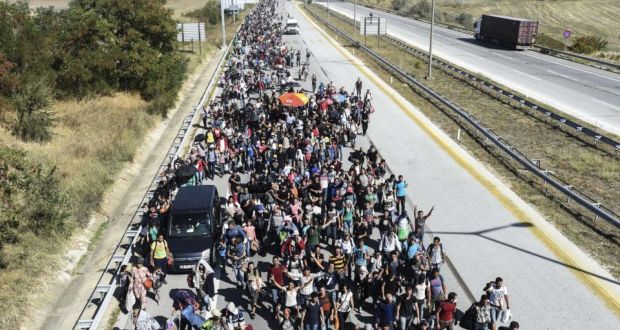
The mass influx of refugees into Europe from war-torn Syria reached unprecedented levels in 2015. Over 870.000 refugees from Syria arrived in Greece by sea, crossing the Aegean Sea. For a few months in the second half of 2015 until early 2016, refugees and migrants enjoyed almost unimpeded passage from Turkey to countries in northern Europe such as, Germany, Sweden, etc. The events sparked tensions in all countries along the route leading to the closing of boarders along the Balkan route and to the controversial EU-Turkey refugee agreement that saw Turkey agreeing to take back all refugees and migrants, including asylum seekers, who reach Greek islands. In turn, the EU committed to resettle Syrian refugees from Turkey and to provide 6 billion euro in assistance to improve the conditions for refugees in Turkey. Despite the overall positive attitude of the Greek people in assisting refugees who arrived by sea, tensions run high within Greece, a country already hit by a massive economic crisis since 2010 Despite such tensions, a similar story emerged involving Greek refugees in Syria in WWII. This is the story of Greek residents in many islands in the Eastern Aegean Sea during WWII, who, following the famine that resulted from the German occupation, crossed the Aegean Sea into Turkey and then arrived in Aleppo and Homs in Syria, where they found safe refuge. Over 30.000 islanders attempted the cross with small boats during the night in order to avoid being spotted by the German Navy. In this exercise students are asked to stand in the shoes of persons fleeing war. They may use historical figures as examples. There are many examples in the press and in various curricula. Students are asked to produce short memoirs narrating the fleeing of a warzone and reaching a safe heaven in a third country. Students may work in groups. The aim of the exercise is to facilitate the building of a “stand in their shoes” scenario and to support students in becoming creative thinkers by embarking on the task of writing a literary piece (a short memoir) accounting for particular events, feelings and ideas in a situation when one has to flee war. By completing this exercise students should be in a position to fully grasp basic issues of migration and the refugee crisis. They also develop skills of emotional involvement and understanding of the suffering of fellow human beings in a rather structured way and not as a plain empathy activity. They also cultivate their writing and narration skills (the latter is considered an emerging 21st Century skill). This exercise is a type of strategic writing that focuses both on skills and causes. It is also an excellent opportunity for collaborative work and for the introduction of brainstorming techniques to a young audience, such as Brain Writing (the teacher/facilitator introduces the theme and asks students to write their own ideas before a discussion commences in order to avoid bias and influencing). Another technique is to focus on the generation of as many questions as possible by the students. Here are some initial ideas:
|
Another TEC activity ‘Words that wound’ could be used to bring into the classroom issues of refugee treatment in the hosting community: https://portal.opendiscoveryspace.eu/en/tr-activity/exercise-7-words-wound-851633
|
This is a group activity in which young learners are explicitly asked to spot and discuss certain (very basic) devices used in hate speech. The activity should be undertaken in a group responding together to a text, video, speech etc. or a combination of both. Here is a bit of theory behind this approach. J. L. Austin investigated language use as a type of performance. Following the latter Wittgenstein, he rejected the importance of utterances as descriptive statements in a pictorial sense. Austin talked of speech as action: For example, when the groom says “I do”, he is not describing (declaring) a state of affairs in which so and so is true (or false), but he is rather doing something: he is performing an action. The same is the case with other examples, such as when one utters “I bet you 20 euros that England will go out in penalties”, “I promise to return this loan in 2 months”, “Je suis…”, “ich bin…”, etc. In all these instances, promises, bets, acts of solidarity, etc. are actually manufactured by our utterances. Austin calls these bits of language performatives, juxtaposing them with constatives that are descriptive in nature (declarative statements). In addition, he talks of constatives as locutionary acts and performatives as illocutionary acts. The aim of a locutionary act is to truthfully describe a state of affairs (“there is a blue car in front of the house”), while the aim of an illocutionary act is the effective execution of an action through speech (“I do”). There is a third type of a linguistic/speech act: The perlocutionary act. It describes the effect that our utterances might have on a hearer. The activity proposed here is focusing on the effect that a bit of language might have on a person or a community that has fled home due to war or a natural disaster and is already under enormous stress. This is a particular type of perlocutionary acts of speech that deserves our attention (especially its many appearances and disguises in the classroom setting) and it is the one intending to cause harm to a hearer, an outsider, a foreigner, a group in a vulnerable position, etc. by deploying the weapons of hate speech. Whether in the form of racial abuse, propaganda, fake news, exercises of authority, etc., hate speech is considered a major issue and it affects all aspects of public life, including, naturally, schools and classrooms. It is a truism that hate speech causes harm to those targeted. Recent research in the field of neurobiology has been looking into mapping the type of harm involved. According to a whole new body of evidence in various studies (Barret 2017), “words can have a powerful effect on your nervous system. Certain types of adversity, even those involving no physical contact, can make you sick, alter your brain — even kill neurons — and shorten your life.” In this context and age-group (9-12), we focus on the uses of cultural stereotypes specifically framed to dehumanise a targeted group, presenting it as collectively possessing negative, different or dangerous traits. Contemporary typical examples include depictions of members of newly arrived migrants and refugees as being prone to commit violence because of certain so-called intrinsic cultural attributes or due to a natural tendency supposedly “verified” by past historical world events involving previous generations in the country or region of origin. This exercise builds on students’ practice in communities of enquiry, asking them to work more carefully with key concepts in order to analyse basic aspects in a multi-modal text. The aim of this activity is to support students in understanding how hate speech operates in human communication by learning to understand how hate speech affects those that are targeted and with what types of devices.
|
יצירה
In this section students become researchers themselves and are implementing a number of activities.
Session1: students set out to explore the history of the local community by investigating family migration stories. This can be done by conducting interview and videos of members of their families, exploring aspects of their fleeing. Here, the students should be guided to focus also on issues of the fleeing trip itself, by trying to collect information on means, objects, dangers and return.
Session 2: Students are asked to reconstruct the fleeing trip that they have investigated. (For practical issues the students may focus on a family member’s trip that is the result of economic migration).
Session 3: Students, under the guidance of their teachers, should turn their attention to STEM issues involving people movement across the globe. This is the session that concerns the cultivation of navigation and geospatial skills. A list of resources is available here to help teachers support student projects:
|
Spatial Thinking and Maps Skills in Young Children by National Geographic Spatial thinking allows students to comprehend and analyze phenomena related to the places and spaces around them—and at scales from what they can touch and see in a room or their neighborhood to a world map or globe. Spatial thinking is one of the most important skills that students can develop as they learn geography, Earth, and environmental sciences. It also deepens and gives a more complete understanding of history and is linked to success in math and science. Young students also enhance their language skills as they collaborate and communicate about spatial relationships. Students who develop robust spatial thinking skills will be at an advantage in our increasingly global and technological society. https://www.nationalgeographic.org/education/map-skills-elementary-students |
|
Navigation Education Materials by ION In order to foster interest in navigation, the Satellite Division of the Institute of Navigation sponsored the development of navigation educational materials for students. The ION hopes that these materials will facilitate the introduction of navigation in middle school curricula and encourage the involvement of ION members in educational outreach activities. These lessons were developed by the ION Satellite Division in cooperation with students and staff at the University of Colorado Integrated Teaching and Learning Program (ITL). The materials are now available as part of an online digital library: Visit Teach Engineering to receive these materials in online format. The following modules include 10 lessons on a variety of navigation topics. The lessons are designed to be used by middle school teachers on their own or with the assistance of an ION member volunteer. They can be used in the classroom or as part of a club or outreach program. Each lesson includes motivations for the students, background and assessment material for the teacher and mentor, activity descriptions and worksheets, and additional tips and resources. The activities are designed to have minimal cost and to be completed in 1-3 hours by a class of 28 students. Suggestions for scaling up and down are included. Click on lesson titles below to download the lesson materials. Each lesson is comprised of several documents. The PDF version contains all documents in one file for each lesson. Please contact the ION with any feedback or questions you have. The materials are copyrighted by the Institute of Navigation, which grants use and reproduction of these materials for educational purposes only. They may not be used for commercial purposes. https://www.ion.org/outreach/lesson-plans.cfm
|

שיתוף
The activities and projects offer a fantastic opportunity for knowledge transfer activities from the school to the local community. Students can organise a final event in the school year in which they will present aspects of their work. In addition they can focus on myth-busting presentations and debates about migration and the refugee crisis. Students can set up creative presentations, debates, plays, etc. that address such themes.
