Hosted by OSOS , contributed by pepa on 18 February 2019
About the teacher (name, email): Pepa Pavlova – pepa1964@abv.bg, Ani Pavlova
Name of the school: Secondary school of mathematics and natural sciences “Acad. Ivan Tsenov”
Location: Bulgaria, Vratsa
Related links: https://ppmg-vratsa.github.io/uchilishte-poslanik/index.html
Description:
With the increased usage of digital technologies science and its innovations have become far more open, united and globalized. As an answer to the numerous challenges which present themselves in this rapidly changing field it is of great importance that 3 strategic priorities are present: open innovations, open science and a general openness to the world.
Sharing our conviction for an open school and an open society we would like to popularize our unconventional ideas and approach to topics, connected to young people. The notion of a collision and accelerator energy which bring fresh ideas and beneficial findings lies at the core of our work. Thanks to that, we were able to establish the high school “Open Schooling Hub”.
Project activities
1.„A BEAMLINE FOR SCHOOLS “
In 2017 and 2018 students of the school created a project with which they participated in the competition organized by CERN, called School accelerator 2018.CERN or also known as the European organization for Nuclear Research offers students from all over the world the opportunity to create and conduct a scientific experiment with the usage of one of the complex’s proton beams. The participation of a student from our Secondary School in the first Bulgarian Summer School in CERN pushed us to use our knowledge and abilities to make an interactive presentation. There were considerable differences in views, but even more ideas and endless energy during the work on the project which made the young people feel like an actual part of the scientific community. The 1-minute video created by “The children born from asymmetry” showcasing the main aspects of the experiment can be viewed at:
https://www.youtube.com/watch?v=bF6QGXaAj68
We took part in the OSOS project “CERN Masterclass”
2.The Internet of things
Thanks to the joint initiative with an already graduated student Dimitar Varganov, who is a representative of the Romtech -3C company, students succeeded in studying and presenting the innovations in lighting technologies by using a 3C LED lamp controlled by a smartphone. By learning about the principles of LED lighting, the technical characteristics and the pros and cons of this type of lighting pupils were provided with enough information about the novelties in this sphere. With the help of this model the company participated in one of the biggest digital exhibitions-Light and Building Innovations Frankfurt 2018.In addition, the youth ambassadors created helpful posters introducing the advantages of such lighting models.
3. 3D printing
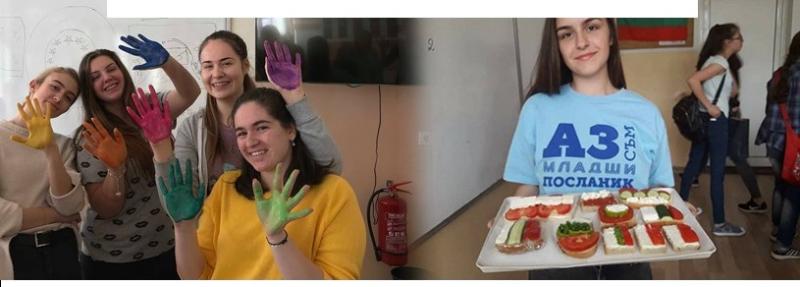
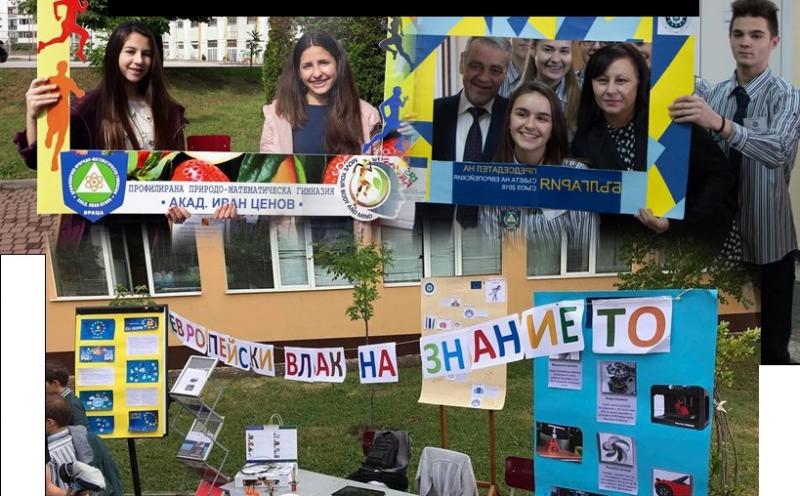
Principles of 3D printing, designing and bringing to life models of the European Parliament's layout and small robots was one of the main initiatives, which presented the technologies of the 21th centuries to the youth in our Open Schooling Hub. The posters made by our students about the 3D printing's role in the industry and the demonstration of the printing process was presented to the citizens of our city. The entertaining way of presenting STEM and digital skills has allowed us to affiliate with other people.
4. World Schools Style debate on "This government wants to ban the development of a strong artificial intelligence."
Legal and ethical standards related to the privacy and the safety of people has been involved in the course of the debate. Attention has also been paid to the tendencies in the rapid development of robots and how this could lead to changes in the labour market by providing, shifting and losing some work positions. Our students are extremely passionate about this theme and were very curious to find more information about the artificial intelligence. The debate was the cherry on the cake of the event, because the young people had the opportunity to show their democratic ability to express opinion, critical thinking and argued protection of their personal point of view. This is the superlative form of the active European citizenship formation.
In conclusion we can say that our activities brought only positives to the school community and proved that OSOS methods are extremely fascinating for the students, because they are spending their time on something meaningful. Every project they made is connected with the needs of the society and that's why they have no problem presenting their work in public. Our school won the golden cup of SUPER STEM SCHOOL Bulgaria 2018.
Available partnership opportunities:
|
Parents |
Participate in round tables and working with the students on the ethical issues raised during the year. |
|
Academic Lecturers |
-A public lecture by engr. Aleksandar Hristov-former student of the school was organized around the topic of”European Sciences-accessible to everyone”.Mr. Hristov is part of the Bulgarian team at CERN and works at the Institute for Advanced Physical Studies in Sofia.The presentation illustrates the scientific and technical accomplishments of CERN and their application in different fields. -joint work with docent Venelin Kozhuharov from the Faculty of Physics at the Sofian University.(“School accelerator” Project) -Participation and good results from CODEWEEK. |
|
Space industry |
Mentoring in a Hackathon event and lectures on relevant subjects. |
|
Municipality |
All public events were organized in correlation with Vratsa Municipality, Regional Administration Vratsa, representatives from the Ministry of Education and Science, Europe Direct and the Informational agency of EU in Bulgaria. |
Inclusion of RRI - Responsible Research and Innovation – principles:
|
|
Students contacted experts in the subject who worked in the Accelerator, sharing with them the achievements unlocked in the course of the activity. |
|
Public engagement |
The results of our accelerator were shared at public events on a national level and were further enriched with the assistance of Maria Gabriel – European commissioner of Digital Economy and Society, Vladimir Urutchev and other important figures of our municipality. |
|
Gender Equality
|
Our team worked hard, regardless of gender and we drew inspiration from both female and male scientists in the field. |
|
Science Education |
This accelerator proposes that students use STEM concepts through Project-Based Learning, providing them with knowledge and skills that will capacitate them to solve problems in an innovative way according to 21st century education. The project has great scientific value and its findings can prove to be extremely beneficial in the future. |
|
Ethics |
The students will take into account all of the aspects of the issue and work in a professional setting with teachers and interested stakeholders so as to reach the final goal of the project. |
|
Open Access |
Through their participation in this Accelerator students accepted the CERN Open Access policy while doing the project for the competition „A beamline for schools “. In the preparation of the debate, the participants and their teachers used open EU resources on topics related to Artificial Intelligence. These open resources enriched their knowledge about this issue as one of the most important for the contemporary society. Using digital educacional tools students acquired new knowledge in the field of Particle Physics, Robotics, Photonics, characteristics of LED lighting and innovations in this sphere, implementation of 3D printing with their own designs. With the acquisition of these STEM skills, students develop the Accelerator in the best possible way and prove themselves to be motivated, innovative and creative young people who understand the importance of the open knowledge to society. Presenting the Accelerator in front of communities on regional and national level, sharing the Accelerator in OSOS network and the Bulgarian network of European Parliament Ambassador Schools will help us share the ideas of this Accelerator with wide range of young people. |
Sharing phase.
All results from the activities were presented to fellow students from different schools in the city in specially organized events for that purpose. The public lecture about CERN was presented to the open public and covered by the local media. The practice was shared as well on a seminar for senior councils in Brussels. During the Open doors day, the students were able to present 3D printing as well as LED lighting using a smartphone App to a large audience of young people from Vratsa.
The interest that the local authorities showed to these topics helped the popularization in the local media outlets.
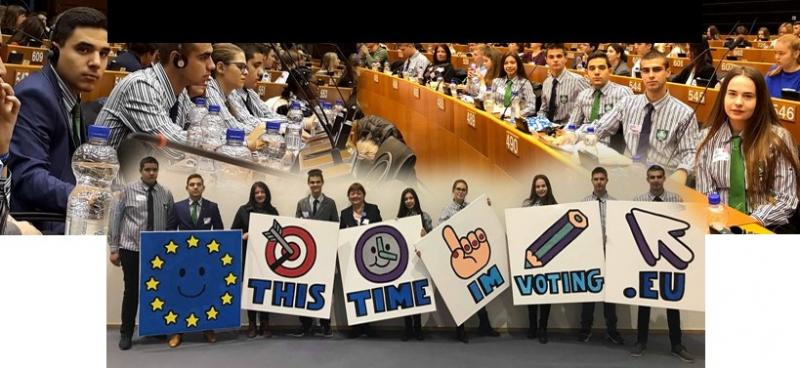
Our participation in the European Youth Parliament in November in Brussels allowed the participants to share their ideas and projects with other young people from whole Europe.
Every material for the project is accessible on
https://ppmg-vratsa.github.io/uchilishte-poslanik
Tundke
We all possess the ability to use our minds as thinking mechanisms, but the real question is whether we are capable of actually utilizing the full potential of our mental capacity. As a result of our comprehensive research of the many aspects in the field we are able to expand our knowledge and capabilities which enables us to create STEM-related project accessible for everyone.
Challenge phase.
With the fast-paced changes that technological developments present to society, each person must develop skills necessary for working in the scientific field, not only connected to conventional practices but also to modern digitalized procedures. Among the people of our society, only few are accustomed to different advancements in our lifestyles and know how to efficiently use them. For this reason, it is important that by showcasing the different aspects and advantages of STEM societal views are changed and the general awareness is raised. In this way, people would be more informed, self-sufficient and would be able to freely gather the benefits of different scientific disciplines.
Kujutage ette
Brainstorming and design phase.
The website, designed and created by the students themselves for the purpose of EPAS Program, gives open access to the projects and initiatives included in our Accelerator “Let me EnterSTEM you!” By using this platform, we want to share with the educational community innovative methods and approaches and examples of good practices in STEM education.
The students participating in the Accelerator had the opportunity to gain new knowledge and skills in STEM subjects and valuable practical and technical skills for making video clips, posters, Prezi presentations, leaflets, etc.
Through team work students acquire social and democratic skills such as communication, creativity, critical thinking and problem solving.
Loo
Implementation phase.
The students, together with their science, computer science and English teachers, created a site, on which they presented in creative way themes that might have been a bit distant to the European Institutions and European Science Area.
The students used their skill in programming and 3D printing in order to create their models.
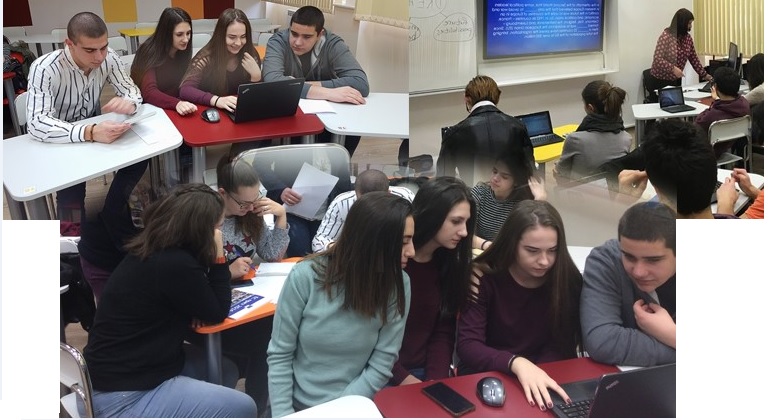
Every activity was proceeded by a group discussion and teamwork, that lead to creating materials for that activity.
During their work for the project-competition “A beamline for schools” the students had to present a scientific explanation for their experiment, presented in a one minute long clip. They were able to express the idea in a most attractive way using their artistic abilities. The clip can be found here - https://www.youtube.com/watch?v=bF6QGXaAj68
Preparing for the debates allowed the students to acquire new knowledge and skills that were not only connected to the STEM but as well as learn how to participate in a debate with certain rules. It was a forum, in which they showed their argumentative skills in the spirit of tolerance and correctness
The direct line to the business also brought them new knowledge for the management models there.