Hosted by SALL , contributed by Gaio-Oliveira on 24 November 2022
The project was developed within the scope of the Discipline Skills Workshop. The students focused on the issue of the impact of food choices on the ecological footprint of the Portuguese. And, they tried to raise awareness in younger students to healthy and sustainable eating: “De pequenino se torce o pepino”.
Taust
AERT3 is located in Gondomar, forming part of a community with economic and social characteristics, typically on the outskirts of a large city. AE is an Eco-Group, develops multiple projects such as Eco-Schools, e-twinig projects and Erasmus+, and promotes the Ciência-Viva na Escola Club
The project was developed within the scope of the 10th grade Skills Workshop, which is part of the Innovation Plan and aims to ease the impact of the transition from the 3rd cycle to the secondary, a challenge for which students do not always meet the minimum requirements in terms of comprehension, oral and written expression, adequate and diversified vocabulary, specific nomenclatures. This workshop privileges the practice and experimentation of different skills, contributing to individual development, having as reference the Profile of Students Leaving Compulsory Schooling. Thus, in two classes, this was the space/time where it was possible to problematize the issue-problem and develop awareness of the issue of food options and their environmental impact. SALL was designated “OUR FOODPRINT” and also integrated the activities of the CCVnE and the Science exhibition of the AE.
Eesmärk
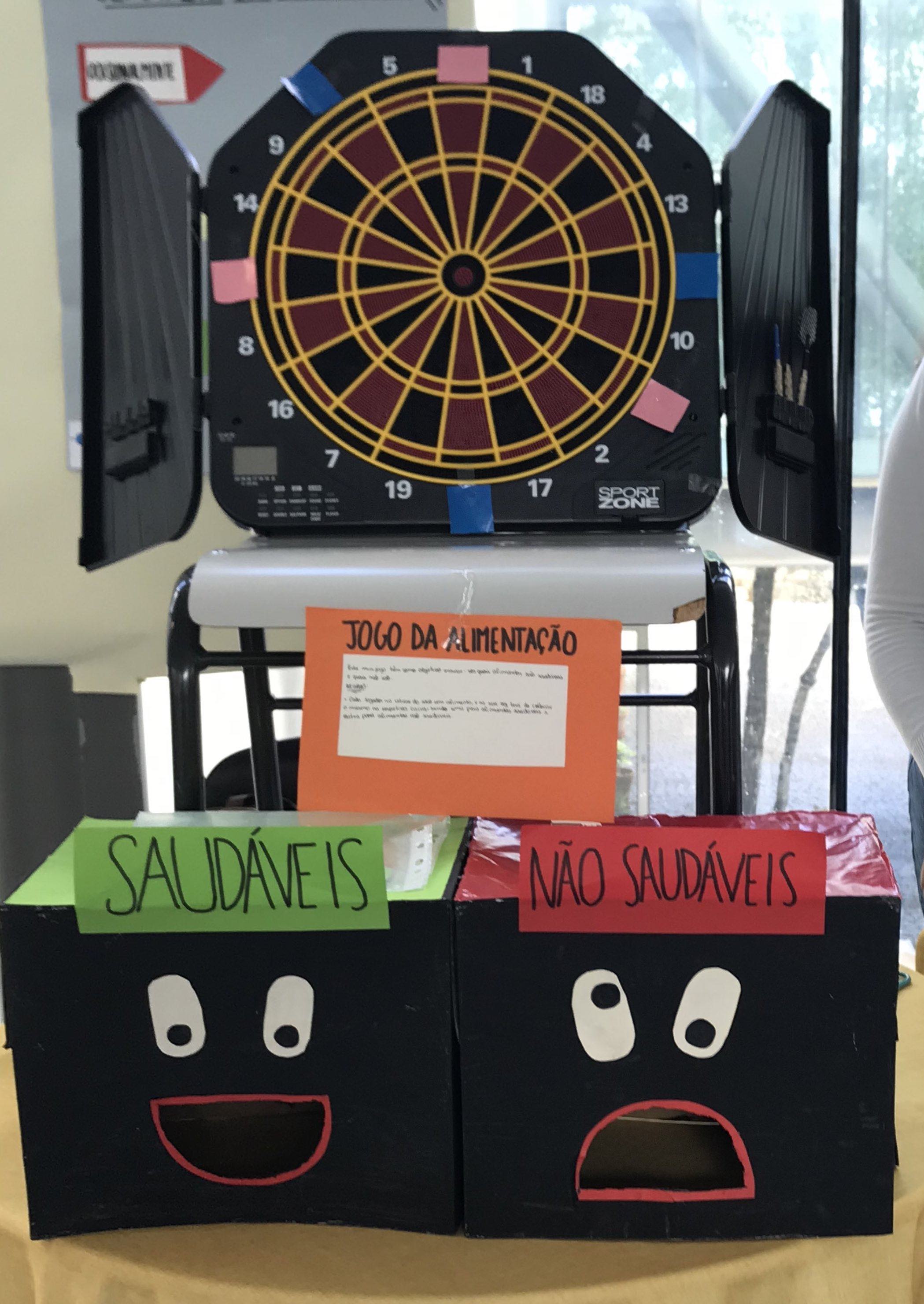
The problem “How to raise awareness about changing eating habits and zero tolerance for waste?” it was approached, firstly with the students in the classes, so that they too can be aware and develop projects/initiatives with others. The research and organization of data about food options in Portugal made it possible to know the reality and put in perspective educational games, the production of posters and a logo that were shared at the Science Fair (June 2) open to the community (partners).
The “solution” of sensitizing others allowed the students involved to gain greater knowledge of the reality of the country and the school, as they also carried out research on the choices that the school makes, as well as the treatment of waste. This appropriation of
The problem also enabled the development of communication and interaction skills and in the field of ICT, as well as the production of promotional materials (posters, logo, educational games).
During the Science Fair, the partners were able to get in touch with the built materials, dialogue with the students, and learn about some concepts through games.
Koosloome huvigruppidega
Given the characteristics of AERT3, with wide dynamics with different partner entities within the scope of the various projects and in particular with CCVnE partners, this project was supported both by the availability of the community itself to reflect on the problem and, with greater relevance and prominence in the students directly involved with their participation in two online lectures promoted by DECOJovem in the young consumer week. Having shared common objectives of “preparing young consumers for the future”.
The most relevant partners/recipients were all community members who participated in the educational games, came into contact with the posters, posters produced by the students involved, alluding to national data on consumption, waste and food processing, which took place on the 2nd of June , in which the Science Fair promoted by CCVnE took place.
Rakendamine
The selected problem was organized based on several proposals from the students involved, encouraged by watching videos, analyzing news and researching data on different platforms, focusing on the proposed theme “Sustainability of food systems”. As it was, for most of these students, a first contact with the problem, it assumed several proposals for projects to be carried out, according to the sensibilities and concerns of the dimensions that the theme provides.
Although only two classes were involved, the central problem was agreed upon by all those involved: How to raise awareness about changing eating habits and zero tolerance for waste?
Subsequently, a central problem was worked on in groups of students, involving research into data on food consumption, production and preparation/processing of foods, creation of informative posters (with research syntheses), posters with appealing images to the various sub-themes and even the production of games that allowed interaction with the community at the Science Fair.
Refleksioon
The living-lab project, implemented here in particular, despite some constraints related to the fact that it was associated with a 10th grade “Skills Workshop” curricular area of the AERT3 Innovation Plan, corresponding to 50 min, which, in this case, it was taught by two teachers from group 520 who did not have any other subject with the class and, thus, required time for the students to get to know each other and to establish a longer relationship and knowledge of their characteristics, the various activities that were part of it this route corresponded, for the majority of students, to the development of diverse skills, contributing strongly to the realization of the Profile of Students Leaving Compulsory Schooling, and of “extra” knowledge, in addition to the compartmentalization of the Subject Essential Learning, being able to even understand up
as the realization of a Domain of curricular autonomy, in the sense of the confluence of knowledge and interdisciplinary skills with application to a real problem of their authorship (selected by the students) whose “solutions” generated summoned several components and culminated in the area of Information and communication, taking into account that throughout the course, students had the opportunity to develop relevant areas of competence such as critical and creative thinking, personal development and autonomy, with a fundamental focus on the area of well-being, health and the environment.
Most students showed a committed participation and manifested an awareness and responsibility regarding food choices and waste, developing collaborative work for the common good, envisioning their participation with the purpose of building a sustainable future.
Futurel Plans
The professors involved consider the continuity of this project to be an added value for the AE. As already described in the reflection, perhaps the anchoring in one or more classes as a project undertaken by teachers from the entire Class Council would facilitate both its implementation and its integration into curricular areas that would also benefit the students involved, also contributing as elements of collection of information on student performance and reflected in their grades.