Keywords
Greenhouse effect; global warming;
Objectives (Max 100 words):
Understanding what the greenhouse effect is and how the concentration of atmospheric carbon dioxide changes over time and in different geographical
regions.
Experimenting how satellite observation of the earth's surface can be used to monitor the planet's climate.
Tools and materials:
Lesson 1:
2 flasks of 1l
2 thermometers (accuracy 0.1 ° C)
caps with hole to insert thermometers
baking powder for cakes
water
1 lamp with an incandescent bulb (more than 100W)
32% acetic acid ice cubes (optional)
Lesson 2
computers connected to the internet
Description
The first lesson is aimed to show how carbon dioxide (CO2), a "greenhouse gas", can affect the temperature of the air in a closed environment. An experiment in the
laboratory is followed by an in-depth study, to investigate seasonal changes and identify a long-term trend using satellite data relating to the concentration of carbon
dioxide in the atmosphere.
The hands-on experiment allows you to observe how the temperature varies in two flasks that contain CO2 and air respectively.
1. The two flasks flasks should be exposed to sunlight or lamp light making sure they both receive the same amount of light. The flasks and the lamp must not be moved during the experiment;
2. the two thermometers are inserted in the holes of the caps;
3. to obtain the CO2 it is necessary to mix in one of the flasks 5 grams of baking powder and 20 ml of acetic acid;
4. the two flasks are then closed with the caps in which the thermometers are inserted;
5. the initial temperatures indicated by each thermometer are recorded;
6. Once the lamp is switched on, the temperatures detected by the two thermometers are recorded at intervals of two minutes eight times.
Results
In the flask containing CO2, the temperature will increase more rapidly than in the other. After 10 minutes, a difference of 1-3 ° C is generally created. Students could think this increase in the experiment is not relevant. However, it should beemphasized that a rise of just 2 degrees on the planet would have catastrophic effects. For example, such an increase could cause a rise in sea level resulting in a significant increase in flooding.
immagine
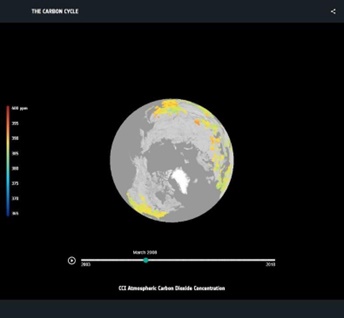
The interactive globe available in Climate from Space showing the concentration of atmospheric CO2 over the time
To get an idea of the increase in atmospheric CO2 from 2003 to 2018 based on real data, you can use the Climate from Space interactive applet made available by ESA at https://climate.esa.int/en/explore/climate-from-space/
The Fast Carbon Cycle
Plants take up carbon dioxide from the atmosphere by photosynthesis as they grow in spring and summer, and return some of it when their leaves die back in autumn and winter. Carbon is also returned to the atmosphere by animals eating plants and breathing out carbon dioxide. The cycling of carbon through living things is known as the fast carbon cycle.
This seasonal growth cycle can be seen in the atmospheric carbon dioxide levels shown on the interactive globe: a peak is reached at the end of the northern winter, before rapidly-growing plants start absorbing carbon dioxide again in the spring. Atmospheric carbon varies most in the northern hemisphere because it has more land, and therefore more plants, than the southern hemisphere. On top of the seasonal cycle there is a clear increase in atmospheric carbon dioxide from year to year – a sign that the carbon cycle is out of balance, mainly due to the burning of fossil fuels.
Carbon and the Land
Changes in land use and land cover are also altering the carbon cycle. The clearing of tropical forests for agriculture has the double effect of adding large amounts of carbon dioxide to the atmosphere from fires, while also removing the trees that absorb and store carbon while they are alive.
Around the Arctic, elevated air temperatures are thawing out large areas of permafrost. This exposes carbon in the soil to decomposition and could potentially release into the atmosphere vast amounts of methane. As northern latitudes thaw and dry out, vast areas of forest, bush and peat are newly exposed to the risk of wildfires. Fire is a key component of the carbon cycle, taking carbon from the biosphere into the atmosphere.