
Hosted by OSOS , contributed by Lydya0103 on 8 July 2020
This project aims to make the students aware of the impact of climate - meteorological factors, especially rainfall in any form, on the environment. In recent years, extreme phenomena such as heavy rainfall have been occurring more and more often, leading to landslides, especially in hilly and mountainous areas where massive forests have been cleared in recent years. Landslides pose serious threats to road structures and construction in general.
• It is important for students to know the effects of landslides and to participate in activities within this project to find strategies to reduce landslides.
In recent years there are more and more natural disasters that affect the planet that may be the consequence of a progressive global warming caused by increasing CO2 emissions produced by human activities, the massive deforestation of forests in recent years has left the hills empty being a real danger of landslides. land especially in the hilly and mountainous areas that destroyed agricultural areas, homes but also other objectives.
It is very important to engage in a new approach to the economy that reduces or eliminates landslides in the identified areas through deeper knowledge and sharing of the issue through media coverage on educational sites.
The project was designed for a new vision of teaching that will develop new strategies for how teachers' roles and conditions can support and enable deeper learning for students.
In order to study, analyze and understand the phenomena of the physical world in which we live, in detail, we will have to build models from quantitative measures, able to make predictions and compare with subsequent measurements.
We will work in depth on Thermology (climate predictions, weather conditions, soil type analysis, land stability, case studies on human settlement risks near landslide-prone hills, identifying types of plants and shrubs to support the soil against landslides, starting from what students know about the main natural disasters, the phenomena they produce related to daily experience, to experiments and tools for building concepts and operational capabilities (PBL + IBSE).
We will also discuss impact studies on landslide evolution and area mapping with Geography teachers, as well as experts from research centers at weather stations, environmental guards.
This activity will also address knowledge about physics that will present students with physical phenomena to understand the terminology of how storms occur, how the population should be protected, the rhythm of the seasons; etc., which it will traditionally achieve.
Feel
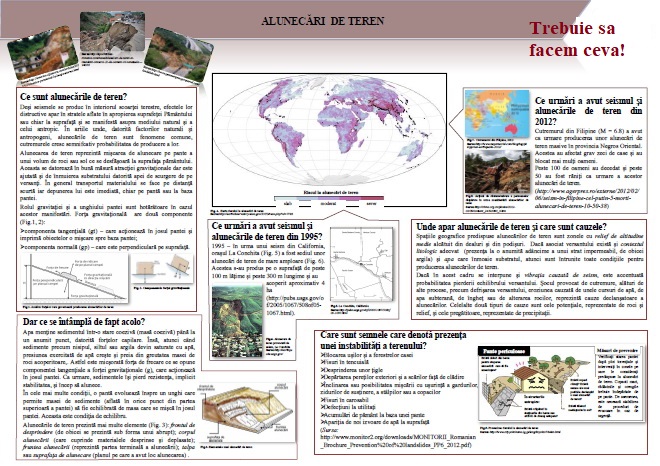
What are landslides?
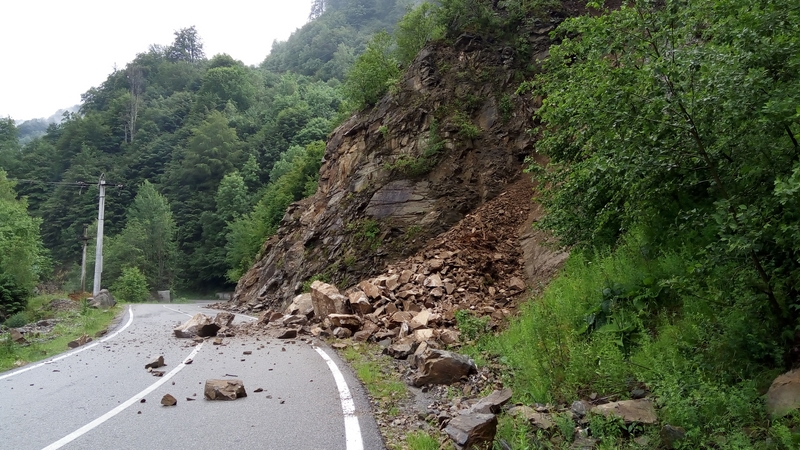
Represents displacements of rocks, which form the slopes of hills, slopes of hydro-improvement works or other land improvement works and can occur along the slope or sideways, as a result of natural phenomena (torrential rains, collapses of caves, erosions earthquakes), or even as a result of human activities. Landslides can lead to catastrophic consequences: destruction of buildings by moving rock layers under their foundations or by covering avalanches; destruction of railways, streets, power lines and telecommunications.
Landslide signs:
Cracks (cracks) on the ground, on asphalt, in the walls of buildings. Inclined trees on all sides, poles and fences displaced. Sudden disappearance of water from wells and springs. Landslides occur everywhere, occurring when masses of stone, earth or mud move on a slope. They can cause small or large masses of earth and rocks and can move at different speeds, being triggered by storms, heavy rains, melting snow, deforestation, earthquakes, volcanic eruptions, fires or by changes in terrain produced by humans.
Imagine
The project will take place in the next school year being attached to an optional subject.
The students have to identify the risk areas prone to landslides but also the areas where these phenomena occurred and to note:
- Factors that affected the landslides
- Search the Internet for geological maps of identified areas
- identification of the causes that led to landslides
- Voluntary actions for afforestation of degraded lands,
- planting shrubs with deep roots for fixing the soil
- planting on steep banks
- Investigation - identification of ideal plants and trees for sloping lands.
One of the causes of landslides:
Severe decrease in groundwater level in the high area, water having an essential role in the survival of trees, especially firs, which do not have pivoting roots, deep;
Create
Establishing teams and roles within the project
Identification of risk areas in the county,
Making connections between phenomena and terminology;
- identification of vulnerability factors,
- filling in some observation sheets - group debates;
- description of some situations regarding the effects of human intervention in nature, the advantages and disadvantages of his intervention;
- identifying the strategies for using rainwater to reduce the risk of floods and landslides,
- lesson visit with the officials/ managers to the environmental protection in the area where are problems to collect the soil,
- experiments about consistency of soil types in the affected areas.