
Hosted by OSOS , contributed by 2dim-meion-komot on 21 June 2019
Πρόκειται για ένα πρόγραμμα που μελετά θέματα αναγκαστικής μετανάστευσης, κυρίως ανθρώπων που εγκαταλείπουν εμπόλεμες ζώνες ή / και καταστροφές. Σχεδιάστηκε με στόχο τη χρήση διεπιστημονικών θεμάτων τόσο από την κοινότητα The Enquiring Classroom Community όσο και από τον τομέα των φυσικών επιστημών (STEM).
Επίσης, στοχεύει στην αντιμετώπιση των τοπικών ζητημάτων της μετανάστευσης και του τρόπου με τον οποίο επηρεάζει την κοινότητα, είτε αυτή φιλοξενεί πρόσφυγες είτε έχει βρεθεί σε καθεστώς μαζικής φυγής.
Υπάρχει επίσης έμφαση στην ανάπτυξη τόσο των πολιτιστικών / ιστορικών όσο και των γεω-χωρικών δεξιοτήτων των μαθητών ηλικίας 9-12 ετών.
Αισθάνομαι
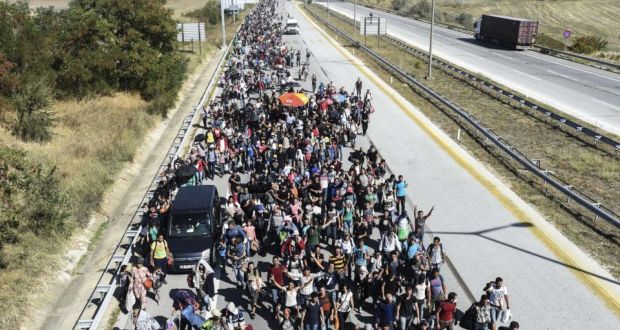
In this section students are introduced about facts and issues on the theme of forced migration.
There are plenty of both historical and contemporary examples.
Choice 1: Focus on forced displacement due to war and conflict. Consider an example concerning the local community, an event involving members of the community fleeing in the past. Be particular sensitive to highly contested political issues that may affect public and school life (civil wars for example), Obviously, the Syria conflict with the biggest movement of people in the history of the world is another example: https://www.worldvision.org/refugees-news-stories/syrian-refugee-crisis-facts
Choice 2: Focus on forced migration due to climate change and issues such as natural disasters, desertification, etc. This is a very good opportunity to discuss current themes and facts concerning this hugely important issue:
- https://www.youtube.com/watch?v=b6QEDbI5zrg
- https://www.youtube.com/watch?v=co5uywe-1Z8
- https://www.gettyimages.com/photos/refugee?sort=mostpopular&mediatype=photography&phrase=refugee&license=rf,rm&page=1&recency=anydate&suppressfamilycorrection=true
Φαντάζομαι
In this section students are asked to imagine what it is to flee your country
The TEC training activity ‘On fleeing war’ offers an excellent starting point: https://portal.opendiscoveryspace.eu/en/tr-activity/exercise-7-fleeing-war-stories-and-counter-stories-851651
|
Students are asked to stand in the shoes of persons fleeing war. They may use historical figures as examples. They can be asked to source examples in the press and in their own curriculum. Students are asked to produce short memoirs narrating the fleeing of a warzone and reaching a safe heaven in a third country. Care should be taken in this exercise where there are children in the class who may have experienced the trauma of forced migration or war. |

Another TEC activity ‘Words that wound’ could be used to bring into the classroom issues of refugee treatment in the hosting community: https://portal.opendiscoveryspace.eu/en/tr-activity/exercise-7-words-wound-851633
|
This is a group activity in which students are explicitly asked to spot and discuss certain devices used in hate speech. The activity should be undertaken in a group responding together to a text, video, speech etc. or a combination of both. This builds on earlier exercises looking at political aesthetics and hate speech and offers a language and skill set to see how hate speech operates |
Δημιουργώ
In this section students become researchers themselves and are implementing a number of activities.
Session1: students set out to explore the history of the local community by investigating family migration stories. This can be done by conducting interview and videos of members of their families, exploring aspects of their fleeing. Here, the students should be guided to focus also on issues of the fleeing trip itself, by trying to collect information on means, objects, dangers and return.
Session 2: Students are asked to reconstruct the fleeing trip that they have investigated. (For practical issues the students may focus on a family member’s trip that is the result of economic migration).
Session 3: Students, under the guidance of their teachers, should turn their attention to STEM issues involving people movement across the globe. This is the session that concerns the cultivation of navigation and geospatial skills. A list of resources is available here to help teachers support student projects:
|
Spatial Thinking and Maps Skills in Young Children by National Geographic Spatial thinking allows students to comprehend and analyze phenomena related to the places and spaces around them—and at scales from what they can touch and see in a room or their neighborhood to a world map or globe. Spatial thinking is one of the most important skills that students can develop as they learn geography, Earth, and environmental sciences. It also deepens and gives a more complete understanding of history and is linked to success in math and science. Young students also enhance their language skills as they collaborate and communicate about spatial relationships. Students who develop robust spatial thinking skills will be at an advantage in our increasingly global and technological society. https://www.nationalgeographic.org/education/map-skills-elementary-students |
|
Navigation Education Materials by ION In order to foster interest in navigation, the Satellite Division of the Institute of Navigation sponsored the development of navigation educational materials for students. The ION hopes that these materials will facilitate the introduction of navigation in middle school curricula and encourage the involvement of ION members in educational outreach activities. These lessons were developed by the ION Satellite Division in cooperation with students and staff at the University of Colorado Integrated Teaching and Learning Program (ITL). The materials are now available as part of an online digital library: Visit Teach Engineering to receive these materials in online format. The following modules include 10 lessons on a variety of navigation topics. The lessons are designed to be used by middle school teachers on their own or with the assistance of an ION member volunteer. They can be used in the classroom or as part of a club or outreach program. Each lesson includes motivations for the students, background and assessment material for the teacher and mentor, activity descriptions and worksheets, and additional tips and resources. The activities are designed to have minimal cost and to be completed in 1-3 hours by a class of 28 students. Suggestions for scaling up and down are included. Click on lesson titles below to download the lesson materials. Each lesson is comprised of several documents. The PDF version contains all documents in one file for each lesson. Please contact the ION with any feedback or questions you have. The materials are copyrighted by the Institute of Navigation, which grants use and reproduction of these materials for educational purposes only. They may not be used for commercial purposes. https://www.ion.org/outreach/lesson-plans.cfm
|

Μοιράζομαι
The activities and projects offer a fantastic opportunity for knowledge transfer activities from the school to the local community. Students can organise a final event in the school year in which they will present aspects of their work. In addition they can focus on myth-busting presentations and debates about migration and the refugee crisis. Students can set up creative presentations, debates, plays, etc. that address such themes.
