Hosted by OSOS , contributed by MelniciucMaria on 9 July 2020
How can the emissions of your journey worldwide transportation be decreased?
 Could you choose your means of transport so that you produce less CO2?
In this activity, pupils explore how they contribute to CO2 emissions as they travel worldwide. The aim of the activity is to raise pupils’ awareness of the drawbacks of traveling in general and in relation to their own traveling behavior. Students from two different countries will work on this project (ex. Romania and Greece). Groups of students from one country will find different ways to get from their city in the partner school's city usign different means of transport.
By the end of this activity, pupils have become aware of the fact that different forms of transport have different CO2 emissions and they will also be able to understand and explain the connection between transportation and climate change. At the end of the activity, pupils will organize and participate in an online “climate conference” during which they discuss and negotiate a plan on how they could decrease the overall emissions of transportation.
The activity raises awareness about the environmental costs of the different ways of traveling. Pupils are inspired to consider and discuss traveling options by making comparisons between different CO2 emissions of different itineraries. This activity can be easily expanded to involve local authorities.
The description of the activity
The activity starts by asking pupils to read an article regarding the carbon footprint of tourism where pupils are introduced to the problem statement concerning environmentally-friendly travelling.
After reading the text, pupils are told to solve the following question:
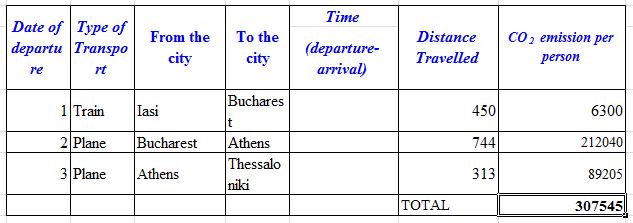
Pupils will try to answer the research question by doing more activities. During the activities pupils will collect data in a table, calculate the CO2 emissions,interpret their data and draw conclusions based on the research. Pupils will use the Erasmus+ distance calculator and a formula to get the total CO2 emissions for the travelled distance.
By interpreting the results from the calculations, pupils are asked to draw conclusions and discuss the following questions:
- Which itinerary will emit the most CO2?
- Is there any relationship between the type of transport and the total CO2 emissions ? If yes, what is it?
- Which is the transport infrastructure in each country?
At the end of the activity pupils will organize and participate in an online climate conference during which the results and conclusions of the research are discussed:
- The purpose of the conference is to negotiate how the emissions for your travels could be decreased.
- The “class delegates” will start the conference by deciding on their own opinions regarding the topic. These opinions are then presented in a meeting of the delegate representatives who are trying to find a shared opinion on the topic. If delegates disagree, the topic is brought back to the class delegates for discussion. If a shared opinion can be found, the solution will be voted in the conference of all the pupils in the school.
- A representative of the Town Hall or the City Council and a representative of the Ministry of Transport can be invited to take part in the discussions and the negotiations. The representative is also asked to share information on how they negotiate and make decisions in the Town Hall/City Council/Ministry of Transport.
- A local environment organization may also be asked to take part in the negotiations in the role of an expert partner
If the decisions of the climate conference include political aspects, pupils can write a proposal for the Town Hall/City Council/Ministry of Transport etc.
Resources needed
- Computers and internet access
RRI principles
One of the key aspects of OSOS is the inclusion of RRI — Responsible Research and Innovation — principles (more information at RRI-Tools.eu). This is how this Accelerator fits into the RRI model:
|
Governance |
At the end of this accelerator students will organize and participate in a climate conference to share their results and to promote awareness on the CO2 emissions caused by travelling. A local environment organization may be asked to take part in the conference to share their expertise in the field. The results of the negotiations of the climate conference may then be used to write a proposal for the Town Hall/City Council/Ministry of Transport to reduce the CO2 emissions in the city by promoting environmentally friendly ways of travelling. |
|
Public Engagement |
This activity aims to engage students in becoming aware of the consequences of travelling. The results of the investigations are shared in a climate conference organized by the students themselves. The activity will also include collaboration with an environment organization and possibly also the Town Hall/City Council/Ministry of Transport. |
|
Gender equality |
Pupils will be working in gender-balanced teams. The activity aims to provide a possibility to collaborate with experts of both genders. |
|
Science Education |
Broadening the understanding of both science and mathematics and their relation are included in the learning methods of the activity. |
|
Ethics |
This activity aims to help students become aware of their possibilities of reducing the carbon footprint of their community. The aim is also to highlight the importance of taking action to fight climate change. |
|
Open Access |
The materials used in the activity have an open access. The conclusion of the activity are shared openly to the audience. |
Accelerator used https://portal.opendiscoveryspace.eu/en/osos-project/carbon-detective-transport-849521
Φαντάζομαι